

If Money were Goats: of Trade Balances and Tariffs

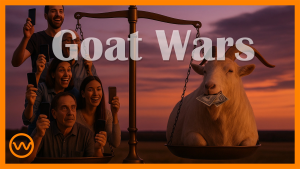
Imagine a world where money isn’t paper, plastic, or digital blips, it’s goats. Real, stubborn, hungry goats.

In this world, every time you buy something from another country, you don’t wire money or swipe a card, you send over a goat. A goat represents your payment, your store of value, your promise. And like money, goats are alive. They can grow, breed, and multiply if cared for. They are not static, they are living assets.

Trade Imbalance

Now imagine two farms: Farm A and Farm B. Farm A sends lots of goats to Farm B in exchange for tractors, electronics, and sacks of grain. Farm B happily accepts the goats and uses them to grow even bigger goat farms, goat-run factories, and goat-funded universities.

Farm A starts grumbling. “We send so many goats, but we don’t get as many goods back! We have a trade imbalance!”

But if you really think about it, there’s no imbalance at all. The goods flowed one way; the goats (also goods, as it were) flowed the other. The trade was balanced at the moment of exchange. What matters is what happens next: Farm B invests its goats wisely; Farm A eats its gadgets and wonders why the goats never return.

Enter Tariffs

Farm A, feeling jealous and a little insecure, builds a giant wall called TARIFFS. “From now on,” they say, “every tractor or gadget coming in costs extra goats!”

Who pays? Not Farm B. It’s Farm A and consumers that bear the cost of additional goats. Gadgets cost more, tractors become luxury items, and the fields grow a little more empty.

Not satisfied, Farm A invents a new trick: Non-Tariff Barriers. “Sure, you can send tractors,” they say, “but only if they pass our 500-point Goat-Safety Inspection!”

The inspection is so complicated, confusing, and expensive that most tractors never make it through. Trade slows. Everyone claps proudly, meanwhile, fields remain barren, and goats, when they do arrive, get stuck in customs mazes.

Meanwhile …

Other farms move forward. Farm B, having accumulated goats, invests in satellites that can beam signals from space. They launch telecom networks, control data flows, and build industries that make gadgets look like yesterday’s news.

Meanwhile, tiny farms like Bangladesh raise goats by making garments, simple shirts, pants, everyday clothes. They trade hard work for goats. These goats, if used wisely, could build their way to larger farms, better tools, and perhaps even their own space programs one day.

Trade is always balanced when you think in goats: goats for goods, goods for goats. The imbalance only appears when you waste what you get, or misuse what you earn.

If money were goats, it would be obvious that tariffs are just taxes on your own goats, non-tariff barriers are just goat-sized bureaucratic mazes and export controls are simply fences around your own goat herd.

It’s not losing goats that makes you poor, it’s wasting the goats you traded for. If you don’t take care of your goats, someone else will. And no amount of fencing, taxing, or maze-building will fix that. Whether it’s garments from Bangladesh or satellites orbiting Earth, the farms that thrive are the ones who know how to use their goats wisely.

But enough about Billy’s family

A lot of the frustration around trade imbalances is not about the fairness of the exchange itself (which is usually fine), but jealousy (or anxiety) about what the other country achieves afterward.

It’s like: “Wait, we gave them dollars for T-shirts… and now they have highways, factories, tech companies, and we’re drowning in debt and cheap clothes?” “They got goats and built an empire, while we just consumed!”

So yes, the resentment often comes later, when one side realizes: The other side invested smartly and became stronger, while they (the jealous side) mainly consumed and now feel relatively weaker.

In that sense, trade jealousy is really just jealousy of how wisely (or aggressively) the received value was used, not of the trade itself.

It’s almost like two farmers: One trades grain for goats. One eats the grain and sits around. The other breeds the goats, sells milk, and builds a farm empire. A few years later, the grain-eater feels cheated,  but the trade was fair all along.

The problem comes later

China breeds the goats: they invest the dollars into ports, technology, buying companies, lending to other countries (Belt and Road). The U.S. eats the gadgets: consuming the goods without building new factories or saving much in return. Fast forward a few years: China has a giant, growing herd of goats (capital, influence, production capacity). The U.S. has a lot of broken electronics and worn-out toys.

The U.S. looks at China’s growing goat empire and says: “Hey, that’s unfair! We sent you goats and now you’re richer and more powerful!” China calmly replies: “You gave us the goats. You could have bred them too.”

The trade imbalance wasn’t the problem. The jealousy of what the goats became is.

Goat Tariffs: How They Really Work

When the U.S. imposes tariffs on China, it’s like this: China sends gadgets (electronics, clothes, machinery) in exchange for U.S. goats (money). The U.S. government says: “Wait, if you want to send gadgets here, you have to pay a goat tax at the border.”

But who really pays the goat tax?

Mostly the American buyer, not the Chinese seller. The Chinese company still needs the same number of goats to cover its costs. So when the tariff (extra goat tax) is added, the price of gadgets goes up for U.S. consumers. The American importer or retailer passes the higher cost on to American customers. In effect the U.S. consumer pays more goats for the same gadgets. China might sell a few fewer gadgets, sure, but America’s own citizens bear most of the cost.

The Big Picture

is that tariffs don’t magically “punish” China, they punish American buyers. Inflation rises because goods get more expensive. Economic efficiency drops: instead of buying the best gadgets at the best price, Americans pay extra for the same thing, or settle for worse alternatives. Jobs relying on cheap inputs (like U.S. manufacturers who need Chinese parts) also suffer.

So in goat terms: Instead of paying 10 goats for a gadget, after tariffs, the American buyer now pays 12 or more goats, but gets the same gadget. The “extra goats” don’t go to China. They get collected by the U.S. government as a tariff, but the real loser is the American consumer’s wallet.

In essence, when a country imposes tariffs, it is levying an additional tax on its own citizens (consumers and businesses), making them pay more for the same goods, reducing their purchasing power (each goat buys less) and impoverishing them relative to what they could have had without the tariffs.

It’s politically sold as “punishing the foreign country,” but economically, it’s punishing the domestic consumer first. The foreign exporter (China, in this case) might lose some sales, sure, but the immediate and guaranteed cost falls on the citizens of the country imposing the tariffs.

A tariff is a tax disguised as patriotism, but paid for by your own people.

It’s not all Evil

Possible Positive Effects of Tariffs

Tariffs can give temporary breathing room to companies competing with cheaper imports. Example: If Chinese steel is super cheap, a tariff can protect U.S. steelmakers long enough for them to survive, restructure, or invest.

Higher prices for foreign goods can make domestic products more competitive. That can lead to more local manufacturing jobs, but only if U.S. companies use the time wisely.

Tariffs are sometimes used as leverage to force a foreign country to change unfair practices (like forced tech transfer, IP theft, currency manipulation).

The government collects the tariff payments (those extra goats). It becomes a new source of tax income, theoretically usable for public projects, though it’s still taken from its own citizens.

But the Big “Ifs”:

If industries become more efficient, innovate, and scale up during the tariff window → long-term gain.
If they just use the protection to raise prices without improving → long-term loss.
If the tariffs stay forever → permanent consumer price hikes and global competitiveness drops.

In short, tariffs can buy time or pressure another country, but if the time is wasted, or if the pressure fails, the cost falls mostly on the American economy itself. Or as you might put it in goat terms:

Tariffs can build a fence to protect your goats, but if you don’t plant grass inside, your goats starve anyway.

The bottom line is that tariffs can serve a purpose if used very carefully, temporarily, and strategically, but if they are used permanently or politically, they almost always end up impoverishing the country imposing them.

You can find a very similar dynamic to trade tariffs and goat economics, but involving technology and market access instead of goats and gadgets.

Space’s own Non Tariff Barriers

As farms move beyond tractors and T-shirts into space and satellites, a new breed of goats, digital goats, is emerging. Services like Starlink and OneWeb want to beam internet straight to every goat pen in the world. Simple? Not quite.

When Starlink or OneWeb tries to enter a new farm (country), they’re often greeted not with open pastures, but walls of regulation: “You need a goat communication license!”, “You must partner with a local goat shepherd!”, “You can’t beam goats into this region without prior goat-authority approval!”

These regulatory hurdles act just like old non-tariff barriers: slowing innovation, limiting access, and forcing global goat herders to jump through endless hoops before they can set up their space-based goat networks.

The effect? Slower connectivity for rural farms, higher prices for goat-internet, and more power kept in the hands of entrenched, traditional goat telecom monopolies.

Whether it’s garments from Bangladesh, gadgets from China, or satellites from orbit, the principle remains: The farms that thrive are the ones that use their goats wisely and don’t strangle them with unnecessary fences.

Imagine for a second …

Country A (let’s say the U.S.) has advanced satellite technology (high-end payloads, rockets, ground stations). Country B (another country, say India or China) wants access to this tech, or wants to launch their satellites using U.S. rockets.

Now Country A might say “If you want access to our launch services or satellite parts, we will impose heavy export controls, restrictions, or require a special tax (export tariffs).” This is basically a tariff or trade barrier on technology, to protect domestic industries (like SpaceX, Boeing, Lockheed Martin) and maintain strategic superiority.

The result is that country B is forced to either pay more (if allowed) or build its own satellites, rockets, or ground stations (more slowly and at greater cost).

Meanwhile, just like with goats, if the protected companies use that time to innovate, they stay dominant (Best Case) but if they become complacent, they get overtaken by others who worked harder to compete (Worst Case).

In satellites, space, and telecom, “tariffs” take the form of regulations, bans, and technology barriers, protecting strategic industries but making things more expensive and slower for the end users.

Countries Prefer Non-Tariff Barriers (The Goat-way)

They’re Harder to Accuse at the WTO

When a country slaps a traditional tariff, it’s like putting up a big neon sign that says: “We are protecting our goats! Sue us!” That’s easy for the World Trade Organization (WTO) to spot and challenge. But when a country says:

“Oh no, we’re just concerned that your goats don’t meet our hygiene standards,” or “We need six years to review your goats’ background checks,” then it’s much harder for other countries to file complaints. It sounds technical, not political, so it flies under the radar.

They Sound Technical, Boring, and “Reasonable”

Governments love NTBs because they sound smart, safe, and legitimate. Instead of admitting “We don’t want your goats because we’re protecting our own herd,” they say: “We’re worried your goats might carry mysterious diseases that could destabilize our domestic goat ecosystem.”

It’s classic bureaucratic judo: The real reason is protectionism, but the official reason is health, safety, national security, privacy, technical compatibility, radio spectrum management, sustainable goat grazing… whatever sounds just boring enough that no one rioting at home notices they’re paying more.

They Achieve the Same Goal as Tariffs Without the Political Heat

At the end of the day, both tariffs and NTBs make it harder for foreign goats (goods, services) to compete. But tariffs create headlines, angry importers, inflation, and messy trade wars. Non-tariff barriers quietly: Stall foreign market entries (delay), Increase costs without headlines (compliance hurdles), Protect domestic producers without needing to admit it publicly.

In goat terms: Instead of building a giant “Goat Wall” that everyone sees and protests against, you quietly set up thousands of small “Goat Paperwork Checkpoints”, where foreign goats just get stuck forever until they give up.

Take Starlink and OneWeb, both trying to provide global internet from space. They have fleets of satellites ready to beam (internet) to every corner of the Earth but many countries don’t just say “No foreign internet!” They say: “You must first apply for a special license.” “You must route all goat signals through our local goat authority.”, “Your goat satellites must store all goat-traffic inside our national barn.”, “We require full goat-inspection rights on your equipment.”

As a result Starlink and OneWeb get delayed for years or blocked entirely, local telecom companies get a goat monopoly, consumers stay stuck with slower, pricier goats (internet service). No tariffs were raised. No WTO case was filed. But the outcome is exactly the same: protect the domestic goat herders, milk the citizens, and blame the weather.

In the end, whether it’s gadgets, garments, satellites, or space lasers, the rule stays the same:

Goats in, goats out, but only the wise herders get richer.

You can build walls, invent mazes, or demand ten years of goat paperwork, but if you waste the goats you receive, you’ll still end up with nothing but a rusting fence, a lot of angry farmers, and a very loud, very empty barn.

Because goats, like money, don’t care about your politics. They only care about growing.

Choose wisely.