
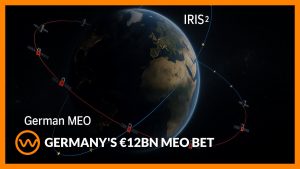

while publicly hugging IRIS²
Germany might be “wholly in favour” of IRIS², which is Europe’s secure connectivity answer to the Starlink-induced existential crisis, but Berlin also appears to like having keys that actually fit the locks. A reported German-only MEO constellation for about €12 billion is the kind of number that makes EU budgeteers reach for herbal tea. You don’t whisper that figure unless you want everyone in Brussels to stop pretending IRIS² will solve every problem while making no one upset.
The official IRIS² storyline is tidy. A public private partnership, a serious concession, a ribbon-cut in 2030 if the calendar behaves. SpaceRISE knits together operators and primes. People smile into cameras. It reads like a group project where everyone promises to do their part and then remembers exams exist. Germany’s hint of a separate MEO ring isn’t betrayal, it’s insurance. You buy a spare parachute before you jump, not after.
Back in the real world, Airbus already holds the next-gen Bundeswehr satcom program and Arianespace just pocketed the launch contract for the two GEO replacements on Ariane 6. That’s not a feeler, it’s execution. If Berlin later green-lights a MEO stack, it won’t start with a blank page. It will start with the people who are already billing. Deploy GEO by the decade’s end, aim MEO for 2032, and politely applaud IRIS2 while it herds cats across member states. Nothing personal, just risk management with uniforms.
Europe’s commercial players are not crying either way. SES is suddenly very large, freshly blended with Intelsat, and booking defense money like it just discovered a new mineral. Eutelsat found religion in government services and LEO, aided by a French state intervention that says the quiet part out loud about strategic assets. If Germany splits traffic between IRIS² and a sovereign MEO, both firms dine. If IRIS2 absorbs the whole mission, they still dine. Tough life.
Let’s not pretend launch capacity is infinite. Ariane 6 is ramping from a standing start, Europe is allergic to buying Falcon rides unless absolutely cornered, and everyone from Earth observation startups to defense customers wants the same calendar slots. A German MEO program would jam one more elbow into an already crowded queue. The upside is obvious. The downside arrives when the same shortage excuses the next delay. Space politics loves a circular argument.
So where does this go. Berlin keeps endorsing IRIS² in public and keeps sovereign options alive in private. Brussels keeps promising multiorbit resilience and writes PowerPoints about interoperability. Airbus keeps building. Arianespace keeps manifesting. SES and Eutelsat keep smiling at both sides like waiters who know the customer will order dessert either way.
The surprise would be genuine consolidation of effort. The safe bet is respectful duplication that gets rebranded as “complementarity” in future press kits.