
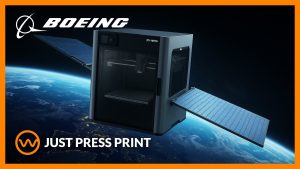

Boeing, clearly bored with the whole “weeks-long assembly” concept, has decided to treat satellite solar arrays like office memos: hit print and get on with it. In a move that sounds less like aerospace engineering and more like sci-fi convenience, the aerospace giant has announced it’s now 3D printing the structural panels that hold solar cells in place. Because why not?
These aren’t your typical 3D-printed plastic figurines either. These are not your average PLA or PETG but supposedly tough enough to survive launch vibrations, thermal shock, and cosmic radiation. According to Boeing, this magical leap into the printer-enabled future will chop off up to six months from the build timeline. One might wonder how long it’s been taking them to build these things if half a year is just the improvement. But hey, we’re all for progress.
Of course, this isn’t just any Boeing division, it’s Spectrolab and Millennium Space Systems doing the legwork. Both companies are Boeing’s in-house space tinkerers, neatly ensuring that no credit escapes the corporate orbit. These freshly printed panels will carry solar cells built by one Boeing arm, assembled by another, and presumably praised in a boardroom by all.
What’s interesting is what wasn’t printed in the press release: actual material specs, environmental stress tolerances, or the word “cost.” Apparently, faster is better even if “what it’s made of” remains under NDA or “still under testing.” That’s fine though, because they’ve got “robot-assisted assembly” and “automated inspections,” which sounds like a productivity dream and a QA nightmare, depending on how generously you interpret “automated.”
Then there’s the subtle flex: 150,000+ printed parts already flying in Boeing products, with over a thousand RF components per Wideband Global SATCOM satellite. Translation: “Trust us, we’ve been printing things for a while, we just hadn’t told you until it was shiny enough to make a headline.” It’s almost poetic, the parts that do the talking (radio frequency) are now being printed silently in the background.
They also whisper something about “scaling this to the 702-class,” which is their way of saying this won’t just be for their toy satellites. No, they’re serious. Big, legacy platforms are next. Which is precisely when any romantic notion of “startup agility” dies in a cubicle meeting full of compliance engineers.
Ultimately, this move reads like a very public act of preemption. The space sector is shifting toward faster, cheaper, and more modular builds. Boeing, with its decades-long rhythm, might finally be feeling that startup breath on its neck. And what better way to say “we can move fast too” than to show off a digital printer with aerospace ambitions?
Whether this 3D leap is a genuine manufacturing renaissance or a well-polished PR fuselage remains to be seen. But if the new era of satellite production is about pressing buttons instead of tightening bolts, at least Boeing wants you to know it owns the printer.