
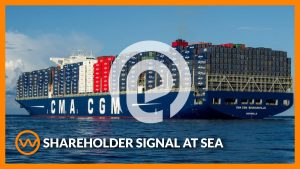

CMA CGM just announced it will roll out Eutelsat OneWeb LEO connectivity across more than 300 vessels, with Marlink handling delivery and integration. The maritime angle is ships want low latency, high throughput, and fewer dead zones, and they want it without turning every voyage into a networking experiment. The less obvious angle is the ownership layer sitting underneath this deal, because CMA CGM is not only signing checks as a customer. It has been sitting on Eutelsat’s cap table as an anchor shareholder since 2022, which means this is what vertical integration looks like when it shows up wearing a “partnership” life-jacket.
The press release leans hard on “multi-orbit” and “multi-technology” as if those words are self-executing. Multi-orbit is a design choice that can deliver resilience, yet it also creates a new kind of complexity that needs real operational maturity. Switching paths across LEO and GEO sounds elegant in a diagram. Out on the water, it becomes handover tuning, and the small issue of humans needing the system to work while cargo deadlines stay rude and non-negotiable.
Marlink’s role is the centre of gravity. Eutelsat sells capacity and coverage. CMA CGM defines the operational requirement. Marlink is the party that has to make it behave like a product instead of a science project. That is why the release talks about an edge platform, orchestration, cyber security, and IoT collection. It is a bid to convince fleet operators that hybrid networking can be packaged into something predictable.
CMA CGM frames the deal as pragmatic, long-term, and aligned with performance and sustainability objectives. That is the corporate way of saying it is tired of connectivity whiplash. Maritime operators have watched LEO reset expectations fast. Starlink normalized “it just works” in a sector that used to accept sluggish service as inevitable. Competitors now have to prove they can deliver comparable experience, plus something extra that Starlink cannot sell as easily. Eutelsat’s “European-based” positioning is that extra, because sovereignty procurement is a real force in 2026. It is also a convenient story when the financial math of building and refreshing a LEO constellation needs supportive audiences to stay supportive.
This is where CMA CGM’s shareholdership starts being strategy. An anchor shareholder is not a passive fan. It is a stakeholder with both reputational and financial reasons to prefer that Eutelsat looks like a credible LEO contender. When CMA CGM puts OneWeb on hundreds of vessels, it is granting Eutelsat a reference customer at scale. That reference has commercial value, political value, and capital markets value. It tells other enterprises and governments that OneWeb is not stuck in pilot mode. It also tells investors that the constellation has demand beyond speeches about autonomy.
There is a circular elegance to it. CMA CGM helps support Eutelsat’s funding story. Eutelsat helps CMA CGM reduce supplier dependence. Marlink monetizes the complexity that everyone else pretends will disappear on its own. The press release calls it a partnership because that sounds friendlier than “strategic alignment between a vendor and a shareholder-customer who wants leverage.”
The timeline claim is the sharp edge: more than 300 vessels in nine months. If that holds, it becomes one of the more meaningful enterprise LEO deployments in maritime, not because of raw vessel count alone, but because speed forces operational discipline. Fleetwide rollouts expose weak support models, weak hardware supply chains, and weak incident response. A slow rollout can hide those flaws behind “phased deployment” language. A fast rollout drags them into daylight, fast.
The sovereignty framing is the tell that this deal wants to resonate outside shipping. “French and European digital sovereignty” is not meant for a vessel captain. It is meant for ministries, regulators, and anyone who might be nudged into supporting European space infrastructure when budgets get awkward. Eutelsat needs large customers, yet it also needs strategic patience from the ecosystem around it, because LEO is capital intensive and unforgiving. Winning visible commercial deployments helps justify that patience.
The omissions are predictable and still worth noticing. No pricing. No performance commitments. No discussion of how hybrid traffic will be prioritized between operational applications and crew usage when bandwidth gets contested. No mention of what “existing LEO and GEO networks” means in practice, which is polite because naming other vendors would turn the document into a custody battle. The release avoids saying the quiet part out loud: maritime connectivity has become a competitive battleground, and nobody wants to be the operator stuck defending a legacy experience while crews and systems demand modern behavior.
CMA CGM’s shareholder position makes the whole thing more interesting. This is a signal that Eutelsat is leaning on aligned shareholders to convert capital support into commercial reality. You can call it synergy if you enjoy that kind of thing. The rest of us can call it what it is: a shareholder-backed deployment designed to prove a European LEO story at industrial scale, with Marlink holding the toolbox and the pager.