
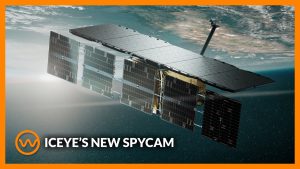

Now With 400 Kilometers of Creeping Power and None of That Pesky ITAR Drama
And just like that, ICEYE has decided that 150 km of watchful SAR coverage wasn’t enough. Because who wants to monitor a modest patch of Earth when you can casually hover over 400 km of real estate in one go? Let’s call it what it is: Gen4 is not just an upgrade. It’s a very polite but pointed middle finger to satellite competition and regulatory bottlenecks everywhere. Wrapped in the friendly tones of “global security” and “sovereign capability,” ICEYE’s latest bird in the sky is a hardcore surveillance asset dressed up like a tech innovation fair project.
They’re pushing up to 16 cm resolution, which is a delightful way of saying, “Yes, we can now spot what brand of soda you’re drinking from orbit.” Combine that with a 2,000 km wide orbital targeting window and 500 images per day, and you’ve basically got the Earth on a time-lapse for any moderately budgeted government. No mention of the energy consumption or signal noise challenges at those ranges, of course. That’s for the customer to discover, after the check clears.
And because no space arms dealer wants the State Department in their inbox, ICEYE loudly touts that Gen4 is ITAR-free. For those not in the loop, that means this system can be shipped, launched, and operated without U.S. export shackles. This is a geostrategic bait magnet for every mid-tier defense ministry with ambitions and a procurement budget that doesn’t speak fluent Lockheed.
But ICEYE’s marketing charm doesn’t stop at international red tape. Their pitch includes simultaneous imaging and downlink at 700 Mbps. Which is like saying your new toaster also does 5G. It’s impressive, but also suspiciously convenient. One wonders how much of this magic survives the leap from brochure to battlefield.
Then there’s the geopolitical backdrop. Post-Ukraine Europe has rediscovered its appetite for sovereign surveillance, and ICEYE is ladling out servings like a Michelin-star spy chef. Portugal, Netherlands, Poland, Finland, they’re all lining up to eat. Some get satellites, some get entire turnkey solutions with training wheels and secure downlink channels. There’s even a freshly cooked joint venture with Rheinmetall in Germany to slap satellites together in retooled auto factories. Because nothing says “military-grade orbital intelligence” like a chassis plant in Neuss.
Let’s also raise a glass to the 41 million euros in R&D money ICEYE pried from the Finnish government. Add that to their full-stack space solutions, and suddenly ICEYE isn’t just building satellites. They’re selling entire sovereign monitoring empires in a box. Great for governments who’d like their own eye in the sky. Less great if those governments have interesting ideas about borders or data rights.
What’s not said? The pricing, the long-term support model, the real-world revisit rates under cloudy conditions, and the maintenance headaches once these glorified flying flashlights start aging in orbit. Also missing: any honest comparison with peer systems from China, the US, or dual-use optical-SAR constellations that may do more with less hype.
And as always, we get the patented ICEYE statement from CEO Rafal Modrzewski, full of reverent techno-nationalist ambition and warm handshakes with the global defense community. Nothing says “disruption” like a press release boasting “dedicated research and innovation” while selling surveillance infrastructure to half of NATO.
So yes, Gen4 is a technical step forward. But it’s also a very calculated geopolitical maneuver, perfectly timed and deliberately vague in all the places that matter. High fidelity imagery? Absolutely. High transparency? Let’s just say the clouds aren’t the only thing these satellites are flying through.
Because in the end, when you build tools that watch the world, it’s always good to ask: who’s watching the toolmaker?