
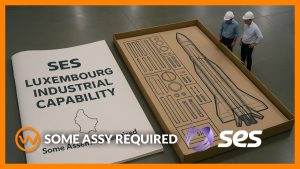

SES has finally decided that watching other people build its satellites is no longer a sustainable business model. After four decades of letting Boeing and Airbus do the messy work, the company now promises to create an “industrial space capability” in Luxembourg. It sounds dramatic. It looks more like SES carving out the glamorous part of the integration process while leaving the heavy lifting with the usual suspects.
The new setup is simple enough. Boeing, Airbus or some upstart like K2 Space will keep cranking out standardized platforms. SES takes delivery, bolts on its software-defined payloads in a shiny new building somewhere in Luxembourg, runs the tests, and rolls the result out the door to a launcher. It is “manufacturing” in the same way assembling flat-pack furniture makes you a carpenter, but if you phrase it correctly, it looks great in a prospectus.
No one is keen to say where this facility will actually sit, or how many people it will employ. SES declines to answer. The Economy Ministry also likes the quiet approach. Which is interesting, because the same government has spent years bragging about the Space Campus at ParcLuxite and just signed public deals to get buildings in the ground. Suddenly, when it comes to numbers that might look awkward next to SES shedding around a tenth of its local staff, everybody discovers the value of discretion.
The official story focuses on speed, cost and quality. Integrate in-house, avoid supply chain delays, iterate faster. All nice, and partly true. Delivery from primes has been a mess, and Amazon, Blue Origin and Astrotech are all throwing tens of millions at payload processing facilities to keep up with launch cadence and national security stress. SES does not have that kind of cheque book, but it can at least try to stop being the operator waiting at the back of the queue behind government birds and megaconstellations.
What really matters is the IP. Al-Saleh repeats that SES has to control more of its own intellectual property. Investors like Davide Leone, who now holds a sizeable stake and carefully refers to SES as the cheapest defence stock in Europe, like that message even more. It is difficult to sell yourself as a hardened defence infrastructure play when your key differentiators sit inside someone else’s clean room. An integration and test facility in Luxembourg looks like a small but firm step toward correcting that imbalance without declaring war on Boeing.
The story also flatters Luxembourg’s ambitions. After pouring around hundreds of euros per head into space through funds, legal frameworks, and a parade of start-ups, the country finally gets to point at physical satellite hardware being built locally, even if most of the mass is imported. For the University of Luxembourg and its CubeSat labs, this becomes the promised career escalator. Instead of exporting the most ambitious graduates to Toulouse, SES can promise them work on “industrial capability” at home. Whether that means real design authority or just supervised integration is a detail left tastefully out of frame.
Then there is Lynk. SES’s investment in the D2D specialist, now merging with Omnispace after a failed SPAC flirt, is the other half of this puzzle. Lynk already has small-scale manufacturing in the US. SES has cash, spectrum access and political cover in Europe. Talk of joint manufacturing in the US and Europe is not just efficiency speak. It is about moving key capabilities onto European soil, tying them to a national champion and upgrading Luxembourg’s role from friendly tax domicile to actual industrial node.
All of this unfolds while SES is still absorbing Intelsat, booking higher revenue, reporting a loss, and laying people off. The company is repositioning itself as a multi-orbit, defence-leaning infrastructure platform at the precise moment European governments are shovelling money into secure connectivity and IRIS². A local integration facility feeds that storyline perfectly. It whispers “reliability” and “sovereignty” to Brussels and national defence ministries, even if the real engineering is still spread across US primes and scattered start-ups.
So yes, SES is bringing manufacturing to Luxembourg, just not in the old-school sense that word evokes. Think of it as a controlled, IP-friendly choke point in the production chain, carefully placed in a country that has decided its future involves more satellites than steel. The result is a neat piece of narrative engineering.
Luxembourg gets its industrial space trophy.
SES gets a better story for defence customers and hedge funds.
Boeing keeps selling buses.
And the people whose jobs are being “optimised” will be invited to take comfort in the fact that some of their former tasks are now part of a grand “industrial capability” strategy down the road.