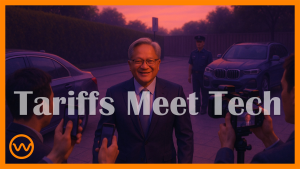

or “How to Lose Friends and Influence Nothing,”
Donald Trump plays the global trade card game with all the finesse of a toddler flipping Monopoly pieces. His big move? Smack NVIDIA with export restrictions like he’s playing Whac-A-Mole with innovation.
Enter Jensen Huang, who didn’t flinch, blink, or break a sweat. Instead, he booked a jet straight to Beijing, probably with dumplings pre-ordered and Mandarin pre-rehearsed. Because what better way to respond to U.S. tech sanctions than to go schmooze the very market you’re allegedly forbidden from?
And what did the internet think? Oh, they noticed.
From industry insiders to ex-army analysts, the consensus was as clear as Trump’s tanning regimen: dumb tariffs don’t block innovation, they reroute it. While Nvidia doesn’t even manufacture their chips themselves (hello, TSMC in Taiwan), the attempt to restrict their designs is like trying to stop Amazon by banning cardboard boxes.
Meanwhile, AMD sat nearby in the tariff timeout corner, sipping its own $800 million projected loss like a stale soda. Huawei, smelling opportunity, probably just high-fived SMIC and DeepSeek over lunch.
The best part? China doesn’t even need Nvidia anymore. At least not like before. With Ascend chips gaining ground, the U.S. might have just shoved China into the golden age of domestic AI development. Bravo.
As for Trump, his move may have been meant to “protect” national interests, but it seems more like handing your opponent your own playbook, and then charging them a tariff to read it.
So next time you hear “Choose the U.S. or China,” remember: business doesn’t pledge allegiance. It signs contracts.
Moral of the story?
Don’t bring a sticky note to a silicon war.