
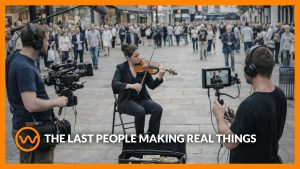

Sarah spent eight years learning her craft, thousands of hours in practice rooms. She plays violin in a chamber ensemble that records for film soundtracks. Professional work. Last quarter, her Spotify royalties came to €37.14. Not per song. Total. For three months. Across everything she’s ever recorded that’s made it onto streaming platforms. That’s roughly 11,000 streams at €0.003 per play. Spotify’s CEO, meanwhile, cashed out hundreds of millions in stock sales over the past year.
Sarah teaches violin lessons now. €40 an hour, twenty hours a week when she can fill the slots. She still takes recording sessions when they come up: €180 for a four-hour session, maybe three sessions a month if she’s lucky. The studio work pays decently. The recordings then live on streaming platforms forever, generating approximately enough money to buy a sandwich every quarter.
This is what they mean by the “democratization of music.” Everyone can upload. Almost nobody can eat.
We’re drowning in stuff to watch. YouTube uploads 500 hours of video every minute. TikTok serves 167 million Americans an algorithmically-optimized feed of fifteen-second clips. Netflix spent $17 billion on content last year and still can’t stop you from doomscrolling past their recommendations. Most of it is astonishingly mediocre. AI-generated articles that read like a thesaurus threw up on a corporate memo. Influencers doing reaction videos to reaction videos. True crime podcasts hosted by people who learned about the case from aggregated aggregation.
The algorithmic slop gets worse by the week. ChatGPT can now write a 2,000-word blog post about “Top 10 Productivity Hacks” in thirty seconds. The post will be grammatically perfect, utterly generic, and wholly devoid of any insight that required a human to actually try anything. Google’s search results increasingly return AI-generated summaries of AI-generated content scraped from sites that republished earlier AI-generated content. Are we eating our own tail?
Meanwhile, actual investigative journalism is dying in real-time. The Washington Post cut 240 jobs in 2023. The Los Angeles Times eliminated over 115 positions in January 2024, following 74 cuts the previous June. Local newspapers are shuttering across America and Europe; more than 3,300 have closed since 2005. The people who went places, knocked on doors, filed FOIA requests, read court documents, and cultivated sources? Getting redundancy packages.
Who needs reporters when you’ve got content creators, right?
Yet, somewhere in that deluge, there are still people making actual things. A BBC team spent eighteen months investigating systematic abuse in UK care homes. They doorstepped facilities and interviewed dozens of whistleblowers. They obtained leaked documents and worked with lawyers. The resulting documentary aired on BBC Two at 9pm on a Tuesday. Maybe 800,000 people watched it live. Another million saw it on iPlayer over the following month. Producer: €52,000/year. Two researchers: €31,000 each. Director: €48,000. Camera operator, sound recordist, editor. Call it €200,000 in salaries alone. Add travel, legal review, insurance, editing suites. Total episode cost: somewhere around €400,000.
ARTE commissioned a four-part documentary series about the Stasi archives. Eighteen months of production. Three researchers who actually speak German. Filming in Berlin and Leipzig. Access to classified files. Real history. Primary sources. People who lived through it. The kind of work that takes time because understanding complex things takes time. Production budget: roughly €1.2 million for four episodes. €300,000 per hour of finished content.
ZDF ran an investigation into fraud in German healthcare billing. Eight months, forensic accountants, leaked billing records, anonymous sources who risked their jobs. The documentary detailed a scheme that cost insurers €47 million.
This is what professional media still does when it’s funded to do it. And it’s expensive because quality is expensive. You can’t investigate fraud with an intern and a Ring light.
Linear television is dying. Everyone knows this. Younger viewers don’t watch scheduled programming. The future is streaming, on-demand, algorithmically curated for your exact preferences at this specific moment.
Fine. Probably true.
But here’s what linear TV still is. It’s one of the last places where actual editorial decisions get made by humans who aren’t optimizing for engagement. Where someone says “this documentary matters even though it won’t trend on Twitter.” and you can’t just upload whatever bullshit you want and call it journalism.
When you turn on ARTE or BBC Four or ZDF, you’re not being served algorithmically-optimized rage bait. You’re watching something that someone decided had value beyond how many clicks it generates. Maybe it’s a boring documentary about Bauhaus architecture. Maybe it’s a French film from 1967 that six people requested. Maybe it’s a news programme that actually sends correspondents to places instead of just reading Reuters summaries.
It’s curated. By people. With, theoretically, some kind of editorial standards beyond “will this drive engagement?” This matters more than you’d think. When everything is algorithmic, you end up with what algorithms optimize for. Strong emotions. Quick reactions. Maximum watch time. Truth, importance, and beauty take a back seat. What keeps people watching is all that matters.
Linear TV is a dinosaur. But it’s a dinosaur that still occasionally commissions the kind of work that takes eight months and a team of researchers. The stuff that streaming platforms won’t touch because the ROI isn’t there.
Here’s how it works when you make something real.
Documentary filmmaker Anna gets a commission from a public broadcaster. It’s a one-hour film about refugee integration in rural Germany. Small towns with declining populations. Syrian families. Language barriers. Complicated stuff. Nuanced. Not going to go viral.
The broadcaster pays €180,000 for the production. Sounds like a lot until you realize:
Anna works on this full-time for fourteen months (€3,200/month if she pays herself a salary, which she usually doesn’t)
Camera operator for 40 shooting days: €28,000
Sound recordist: €20,000
Editor, twelve weeks: €18,000
Two researchers/assistant producers: €32,000 combined
Travel, accommodations, permits, insurance, translator fees: €24,000
Post-production (color grading, sound mix, graphics): €16,000
Archive footage licensing: €8,000
That’s €149,200. Leaving €30,800 for Anna’s production company, from which she still has to pay overhead, taxes, equipment, insurance, accountant fees. Anna herself will gross maybe €18,000 from this project after expenses. For fourteen months of work. That’s €1,285 per month. You can earn more managing a Lidl.
That’s the lifecycle of professional documentary work in Europe right now. You scrape together funding, you make something good, you hope you can afford to make the next one.
Compare this to Netflix. They spent around $15-17 billion on content in 2024. Sounds incredible until you realize they released 589 new Netflix Originals that year: films, series, documentaries, everything. Where does the money go? Definitely not evenly distributed to mid-level creators. Netflix paid €1.2 million for a European indie documentary, then buried it so deep in their algorithm that even the director’s mother couldn’t find it. It “launched globally” in forty countries and got exactly 140,000 views in the first month. Then disappeared. No residuals, no follow-up.
That same filmmaker had a previous documentary air on ARTE. It reached 600,000 viewers on first broadcast, got repeated four times over two years, sold to broadcasters in seven countries, generated €45,000 in royalties over five years. The ARTE commissioning fee was €140,000. The Netflix deal was €1.2 million upfront and then nothing. Sounds like Netflix wins, right? Except the filmmaker can’t make another documentary on €1.2 million that vanishes immediately. She can make three documentaries on €140,000 each with back-end royalties that fund the next project. This is the difference between a media ecosystem that sustains creators and one that extracts content.
Session musicians have it worse. They’re the invisible workforce of recorded music. They’re on every film soundtrack, every TV commercial, every album by artists who don’t play instruments themselves. Professional players. Decades of training. Union rates when unions still have power. A scoring session for a documentary pays €180 for four hours. That’s actually decent: €45/hour for specialized work. A violinist might do three sessions a month. €540.
Then the documentary airs. In Germany, performers’ rights are managed by GVL. Every time that documentary broadcasts, GVL collects royalties and distributes them to the performers. How much? For a regional broadcast on a documentary that gets 200,000 viewers, a session musician might receive €4.20. Not per broadcast minute. Total. For the whole thing. If that documentary gets repeated five times over three years, the musician might see €23 in total royalties. Less than the cost of strings for their instrument.
Why have this system at all? Why collect €4.20? Because at scale, across thousands of broadcasts, across an entire career, it adds up to something. Maybe not much. But something. A working violinist with credits on fifty projects might see €2,400 a year in neighbouring rights royalties. That’s two months of rent. It’s not nothing. But only if someone actually collects it. Only if there’s infrastructure to track broadcasts, calculate distributions, transfer the money. The administrative cost of processing a €4.20 payment is probably €6. The system only works at scale.
None of this is natural. The idea that creators should be paid when their work is used, that’s not some law of physics. It’s a social agreement we made because the alternative was worse.
Go back 250 years. Composers wrote music for wealthy patrons once, got paid for the commission, and then that was it. The score would be copied, performed across Europe, published, sold. The composer saw nothing. Haydn wrote 104 symphonies and died with basically no money. Mozart was buried in an unmarked pauper’s grave.
Writers had it worse. Charles Dickens published novels in serialized chapters in magazines. As soon as each chapter appeared in London, it would be immediately pirated and republished in America. No copyright recognition between countries. Dickens made a fortune in England and not a penny from the American market, which was the largest English-speaking market in the world. He spent years lobbying for international copyright law. Publishers called him greedy.
Performers got nothing at all. You could rehearse for months, perform a piece brilliantly, and some entrepreneur would record it (once recording technology existed) and sell the recordings. The performers had no rights to the recording. Session musicians in early jazz and blues got paid a flat fee of maybe $10 for a recording session. The label owned the recording in perpetuity. Those records sold millions. The musicians got ten bucks.
This is why rights exist. Not because lawyers wanted complexity. Because creators were being systematically robbed.
The first copyright law (the Statute of Anne in 1710) was explicitly designed to protect authors from publishers who would print their work without permission. The Berne Convention in 1886 established international copyright recognition because Dickens and others spent decades fighting for it. Performers’ rights came in the 20th century after musicians unionized and demanded them. Every single protection was fought for. By creators who were tired of making things and watching other people get rich from them.
When you watch a documentary, you’re actually consuming several different layers of creative work. The music has an author. That’s the underlying composition right. Performers, engineers, and producers turned that composition into a recording. Those are neighbouring rights. The film itself required writers, directors, camera operators, editors, researchers. That’s an audiovisual work. Someone commissioned it, scheduled it, and transmitted it. The broadcast signal represents another right.
All of these people did work. All of them contributed value. The system tries to ensure they all get paid something when their work is used. Imperfectly, bureaucratically, sometimes absurdly. Is it complicated? Extremely. Could it be simpler? Probably. But the complexity exists because the creative process involves a lot of people, and nobody’s figured out a simpler way to make sure they all get their cut.
The alternative is: only the final distributor gets paid. Which is what happens in most of the digital economy. Spotify pays artists €0.003 per stream and keeps the rest. YouTube pays creators a fraction of ad revenue and keeps the majority. Apple and Amazon operate similar models. Netflix buys out rights entirely and pays nothing on the back end. In every case, the platform extracts value and the creators get whatever the platform decides they’re worth. Which is: as little as possible.
The rights framework tries to push back against that, despite its flaws. It says: if you use someone’s work, you pay them. Every time. In proportion to the use. It doesn’t always work. The money often doesn’t flow properly. Some creators never see royalties because the amounts are too small to distribute. The system is full of problems. But it’s better than the alternative, which is: nothing. Just platforms and distributors keeping everything, and creators hoping they get famous enough that they can negotiate.
That’s where we’re headed with streaming. The big platforms want buyout deals. Pay once, use forever, no residuals. It’s cheaper for them. And it means creators can’t build careers on back-end revenue. You get your Netflix deal or you don’t, and if you do, you better make enough to survive until the next one, because there’s no royalty stream funding your next project.
Anna the documentary filmmaker? She needs those broadcaster residuals to keep making documentaries. Sarah the violinist? She needs those GVL distributions to justify taking session work instead of just teaching full-time. The system is breaking down, slowly, as streaming replaces linear TV and buyouts replace residuals.
But for now, in this weird transitional moment, broadcasters still commission real work. Documentary filmmakers still spend fourteen months on a story. Chamber musicians still record soundtracks. A system exists that tries to make sure they get paid. Barely functioning, deeply flawed, but still there.
It’s not much, but it’s something.
Understanding how it works matters, because once it’s gone, it won’t come back.
Sarah will eventually stop taking session work. The €4.20 royalties won’t justify the hassle. She’ll teach full-time, maybe take a job at a music school with benefits. In ten years, when someone needs a violinist for a documentary soundtrack, they’ll use a sample library. Or commission an AI to generate something that sounds close enough. Nobody will notice the difference. Nobody will care. Anna will make one more documentary after this one. Maybe two. Then she’ll take a job at a production company making corporate videos. Or pivot to content strategy. Or just leave the industry entirely. The specific skills required to investigate complex stories, to earn trust, to doorstep facilities and cultivate sources over months? Those don’t transfer to much else. They certainly don’t pay.
The people replacing them won’t be better filmmakers or more talented musicians. They’ll just be cheaper. AI-generated scores that cost nothing. Video essays assembled from stock footage and Wikipedia summaries. Content creators who understand algorithms better than they understand storytelling. Or more likely, there won’t be replacements at all. Just an absence. Fewer investigations. Fewer documentaries about complicated things that take time to understand. Fewer people who know how to do this work, because there’s no way to learn it anymore when nobody can afford to do it.
The last generation of creators who knew how to make real things will age out. Their knowledge will go with them. And we’ll be left with what the platforms want to serve us: whatever keeps us watching, whatever costs the least to produce, whatever requires the smallest investment in actual human craft.
This is what cultural death looks like. Not dramatic. Not sudden. Just a slow withdrawal of resources until the people who make things can’t afford to make them anymore. Until the infrastructure that supported them collapses. Until there’s nobody left who remembers how it used to work.
And we’ll all pretend not to notice the difference between a documentary made by someone who spent eighteen months investigating systematic abuse and a video essay assembled from news clips and AI-narration. Between a film score performed by session musicians and a synthetic approximation. Between journalism and content.
Until eventually, we’ll forget there ever was a difference as there were the teams of David Attenborough, Jacques Cousteau, Michael Palin, Anthony Bourdain, Simon Reeve, Joanna Lumley, Benjamin Rich, Louis Theroux, Ross Kemp, Michael Moore, Nick Broomfield, Robert Fisk, Tim Hetherington, and many more who brought us immense value for decades.


SES: Sovereignty With Stock Tickers