
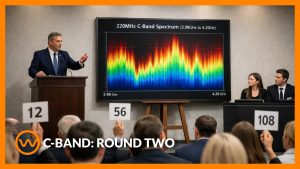

The US is reopening a fight it supposedly “resolved” the first time it carved up C-band for 5G. Back in 2021, the FCC auctioned the 3.7–3.98 GHz slice for a headline-grabbing sum and declared the mid-band drought over. The check cleared, the carriers moved in, and aviation discovered outrage right on schedule.
Now the FCC is pushing into the upper C-band, meaning 3.98–4.2 GHz. Congress hardwired the urgency with the One Big Beautiful Bill Act, which restored auction authority and told the FCC to auction at least 100 MHz from this range by July 4, 2027. The FCC’s November 20, 2025 vote kicked off the rulemaking, with the Federal Register publication landing December 5, 2025, so the clock is not metaphorical.
The part everyone keeps pretending is simple is how much spectrum is actually on the table. The FCC is teeing up anywhere from the minimum 100 MHz to as much as 180 MHz, because “at least” is how you write a mandate when you want the regulators to take the heat for your ambition. More spectrum means more money and more capacity for 5G and 6G marketing slides. It also means more disruption for the incumbents that still use this band for satellite distribution, plus a fresh round of adjacent-band panic from aviation because radio altimeters sit right above it in 4.2–4.4 GHz.
Aviation is no longer playing defense with press conferences alone. On January 7, 2026, the FAA published a proposed rule to require interference-tolerant radio altimeters, with compliance timelines that stretch into the 2029–2032 window depending on operator category. Translation: the FAA is trying to turn “we’re worried” into measurable requirements, and it is not cheap. Reporting has put the upgrade bill in the multi-billion range, which is where “public safety” starts looking like a budgeting method.
The wireless industry’s response is the usual mix of technical framework and political positioning. CTIA teamed up with major aviation trade groups in a joint filing that pushes a coexistence plan and tries to keep the FCC from improvising itself into another airport drama episode. The tone is cooperative. The subtext is self-preservation, since nobody wants a repeat of 2022 when restrictions and delays turned into global headlines.
Then you get the satellite and broadcaster incumbents, who have an extremely inconvenient habit of already using the band. Broadcasters lean on C-band satellite links for distribution, and they are not thrilled about another relocation after the last one. NAB filings have been blunt about protecting incumbent operations and avoiding another forced migration dressed up as “transition.”
Layered on top is the direct-to-device crowd, which is where the story stops being only “carriers versus satellites” and turns into “carriers versus satellites versus satellites pretending to be carriers.” SpaceX wants Starlink to reach phones and not just dishes, and it has been buying its way into spectrum to make that happen. In September 2025, SpaceX agreed to buy EchoStar spectrum licenses in a deal around $17 billion, paired with a commercial arrangement tied to Boost Mobile. That transaction happened because spectrum is the toll booth between a demo and a scaled service.
Once a company pays that kind of money for one set of bands, it suddenly develops very detailed opinions about how other bands should be structured. In the upper C-band proceeding, SpaceX and other satellite-to-phone players have incentives to argue for rules that preserve satellite-friendly access, create usable guard bands, or allow secondary operations where terrestrial networks are “not deployed yet,” which is a phrase that can stretch forever if you say it with enough confidence. The FCC’s docket is officially about flexible use and auction mechanics. The real fight is over who gets durable rights and who gets stuck funding the clean-up.
Meanwhile, the non-SpaceX camp is not sitting quietly hoping for fairness. Verizon signed a definitive commercial agreement with AST SpaceMobile in October 2025, with service talked about in 2026. That is the carrier world buying an insurance policy against being dragged into a single vendor’s orbit, while still getting to say it cares about coverage in dead zones.
Apple is doing its own version of this game through Globalstar, funding expansion for satellite connectivity tied to iPhone features. That matters because consumer devices normalize satellite messaging, and normalization becomes leverage in spectrum debates. Once users expect “it just works,” regulators start hunting for pathways that keep it working, even if the pathway is a regulatory carve-out with a fancy name.
So what is the actual issue with upper C-band, stripped of the theater. The FCC has a congressional deadline and a mid-band hunger problem. Aviation has a safety mandate and a long equipment replacement cycle. Incumbent satellite and broadcast users have existing operations and a very short appetite for another forced move. Direct-to-device players want spectrum access that behaves like terrestrial rights without the same price tag or obligations. Everyone claims they are protecting the public. Everyone is also protecting their business model, because altruism rarely files ex parte letters.
If this ends “cleanly,” expect an auction that clears at least 100 MHz with a transition plan that looks suspiciously like the last C-band transition, plus a loud argument about whether auction proceeds should help fund altimeter upgrades. If it ends “messily,” you get delays, lawsuits, and a new round of mutual blaming where each side swears the other side discovered physics at the worst possible moment.