
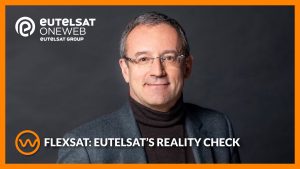

We read ViaSatellite’s interview with Jean-François Fallacher and these are our thoughts.
Eutelsat wants you to meet Jean-François Fallacher as the calm adult in the room, the telecom veteran who will steer a legacy GEO broadcaster into a modern connectivity operator. The interview plays like a guided tour through a company that insists it is both a stable utility and a startup with “drive energy,” which is a cute way to say it needs to move faster while carrying decades of orbital baggage.
Fallacher’s most honest moment arrives early, disguised as a “learning.” Space forces you to anticipate demand years ahead because hardware takes forever to build, launch, and stabilize. He says it like wisdom. It reads like a warning label for every promise he makes later. In telecom you can patch, swap, scale, refarm. In satellites you commit, then you wait, then you hope the market still exists in the shape you priced. If you hear him repeating “anticipation,” you are listening to a CEO pre-writing his defense for whatever slips next.
Then he drops the second learning, the one that matters for anyone who buys connectivity and hates vendor lock-in. In LEO there is no interoperability and no normalization. Nothing is off-the-shelf. Each operator is its own little kingdom with proprietary everything. That is positioning. Eutelsat is telling customers to accept the walled garden, because the walled garden is the business model right now.
The interview keeps trying to make the GEO to LEO shift feel like an orderly transition. It is not. It is a revenue and profit imbalance wearing a strategy blazer. He admits GEO is still most of the business and a bigger chunk of profit, then turns around and sells LEO as the growth engine. Translation: the future consumes capital while the past pays the bills, and the past is on a slow decline that nobody wants to put in a calendar invite.
This is where FlexSat becomes the real story, because it is the moment the company stops pretending every legacy plan deserves to live. FlexSat was meant to be a flexible, software-defined GEO satellite for the Americas, the kind of asset you pitch as the antidote to uncertainty. Demand shifts, beams shift, capacity follows. Very modern. Very reassuring. Then Eutelsat canceled it, calling the business case “shaky.” That word choice is unusually blunt for a CEO who is otherwise carefully polishing every edge.
“Shaky” is about time and returns. GEO satellites still work. GEO video still prints money in the right places. The problem is what happens when you put new money into a GEO project that takes years to show up, while LEO keeps changing what customers think they should get for their spend. Flexibility does not fix time-to-orbit. Software does not compress a multi-year construction and launch cycle. The market does not pause out of respect for your procurement plan.
FlexSat’s cancellation also tells you how Eutelsat now thinks about capital. The interview spends a lot of oxygen on refinancing, bond issues, export credit, and runway through 2030. That is the foundation. They went out and secured the ability to spend roughly a billion euros a year to keep OneWeb operational and to position themselves for the IRIS² era. In that environment, a marginal GEO program that cannot promise returns fast enough becomes an easy sacrifice, even if it was once presented as part of the future.
You can see the narrative gymnastic routine in how Fallacher talks about GEO after FlexSat is gone. He insists Eutelsat will still procure some GEO satellites because orbital positions matter and the business still exists. He points to a partnership satellite in progress with Thaicom. He refuses to commit to how many GEO satellites might follow, which is executive speak for “it depends how ugly the market looks when we have to decide.” This is a company putting GEO on a stricter diet and watching what survives.
When he pivots back to OneWeb, the tone changes. Suddenly there is urgency, learning, iteration, faster operations, better terminals, better ground, Gen 2 planning. He says they are sold out in places like Ukraine, Taiwan, and Saudi Arabia, which reads like proof of demand and also like a polite admission of constrained capacity. Scarcity sells well in B2B. It also buys you time while you build replenishment and pitch the next generation.
Gen 2 is sold as multi-orbit, with inter-satellite links and governmental features, tied to IRIS² and in cooperation with SES. This is where the sovereignty story comes in, dressed as product evolution. Eutelsat wants to be the European alternative to Starlink, the second leg for governments and enterprises that do not want their national connectivity posture depending on a single American system. It is a compelling story in the current geopolitical climate, and it is also a commercial advantage that only works if Europe keeps funding the narrative and if Eutelsat keeps delivering enough performance to justify the patriotic premium.
The interview tries to make the company look focused by drawing a line around D2D. They do not have the payloads for direct-to-device non-terrestrial 5G or IoT today, so they are not chasing it right now. That is unusually sane. It is also another place where the “alternative to Starlink” slogan gets narrower when you actually read the fine print.
Then the sovereignty angle turns from tailwind into handcuffs. Fallacher says they are not selling their ground assets because French authorities blocked the deal. He frames it as a closed matter. The implication is larger. When governments see you as strategic, they will sign long contracts and smile for photos, then they will veto transactions that make your balance sheet cleaner. Sovereignty support comes with sovereignty control. Nobody should pretend this is a free lunch.
Put the interview and FlexSat together and you get the real picture. Eutelsat is trying to run two timelines at once. GEO is the profitable heritage that must be defended and slowly optimized. LEO is the growth platform that must be funded and refreshed on an unforgiving cadence. FlexSat died because it sat in the worst possible spot, a new GEO bet with a payoff curve that looked less charming once the company committed to pouring cash into OneWeb continuity and into the IRIS² future. The telecom CEO is not there to romanticize satellites.
He is there to decide which projects deserve oxygen and which ones deserve a press release about prudence.


SES: Sovereignty With Stock Tickers