


Eutelsat’s refinancing was presented as a financial milestone, which is adorable. The official line says the company completed a major balance-sheet overhaul, closed a €1.5 billion bond offering, and now stands ready for the future. Very polished. Very responsible. Very “nothing unusual to see here” for a company that needed a full political rescue before anyone could pretend the market still believed in the story.
The bond deal was not the story. It was the ribbon-cutting ceremony after the real work had already been done behind closed doors, under fluorescent lighting, with government officials pretending this was all perfectly normal capitalism. By the time Eutelsat announced the closing, the important part had already happened. France had decided that Europe’s sovereign satellite future would not be built around a German-flavored commercial ecosystem. It would be built around a French-controlled operator with enough public backing to survive its own business model.
That is the real story. Not debt. Not notes. Not ratings. Control.
IRIS² sits in the background like the least honest person in the room. Officially it is a European project about secure connectivity, resilience, strategic autonomy, and the usual Brussels buffet of noble abstractions. In reality it is a fight over who gets to sit at the center of Europe’s orbital infrastructure for the next decade. Whoever anchors IRIS² does not just win contracts. That player gets influence over architecture, procurement, integration, political leverage, and the right to call itself indispensable in every future conversation about sovereignty. In Europe, that is better than profit. Profit can disappear. Strategic status tends to linger.
France understood this early. Germany understood it too, though in a more German way, meaning with more committees, more ecosystem language, and more faith that a diversified commercial base would somehow outmaneuver a state-backed national champion once Brussels got involved. That was never a serious reading of how Europe handles strategic industry. Europe talks like a rules-based market and behaves like a family inheritance dispute with PowerPoint slides.
France came to the table with Eutelsat, which after the OneWeb merger became the only European operator that could claim meaningful scale across both GEO and LEO. That mattered. It mattered even more once everyone admitted, without saying so too loudly, that Starlink had turned Europe’s sovereignty talk into a joke with satellites. The continent could give speeches all day about autonomy. It still ended up watching an American private company define the the operational standard in low Earth orbit. Not ideal for anyone who enjoys using the phrase “European strategic independence” with a straight face.
So Paris moved to make sure the answer to that embarrassment would be French.
The awkward bit was that Eutelsat did not exactly look like a triumphant champion. It looked like a company carrying the usual stack of executive optimism floating above some less romantic numbers. OneWeb replenishment is expensive. A company can call itself multi-orbit all it wants. Suppliers still expect to be paid in euros rather than strategic adjectives.
That is where the refinancing comes in as a state-enabled stabilization package designed to remove the one obvious objection to making Eutelsat central to IRIS². A fragile operator cannot anchor a sovereign constellation. A rescued one can, provided everyone agrees to describe the rescue as vision.
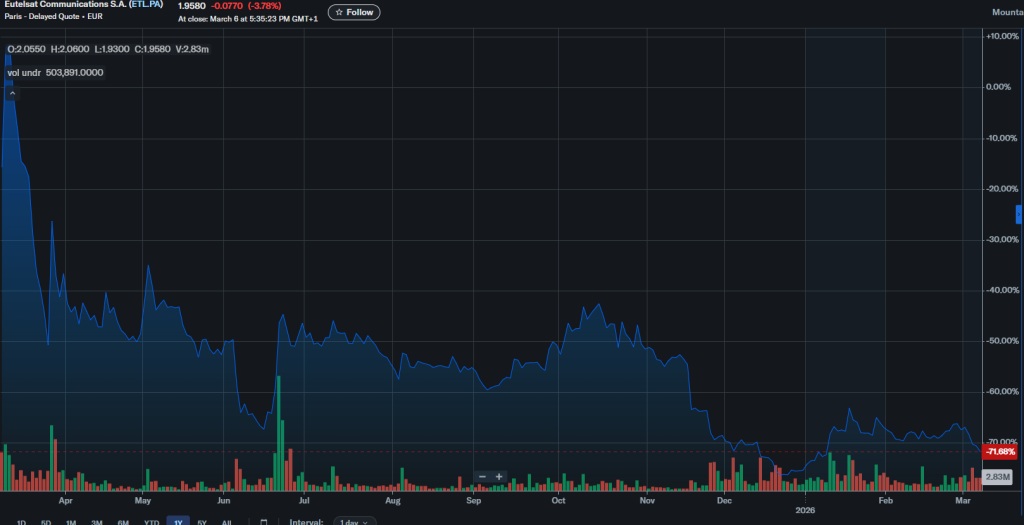
France increased its grip. The UK stayed involved because OneWeb’s history made that unavoidable. Strategic investors played their roles. The bond market showed up after the adults had secured the room. Then everyone got to applaud the closing of the €1.5 billion offering as if the capital markets had boldly rediscovered their faith. They had not rediscovered anything. They had been handed a cleaner risk profile by states that had already decided the company was too useful to wobble. And yet:
Germany, meanwhile, represented the other model. Less champion, more ecosystem. Less central operator, more distributed field of capable firms. On paper, it sounds like something consultants would call resilient while charging by the hour. Germany’s space posture has leaned more naturally toward enabling a wider commercial landscape, with startups, launch firms, subsystem specialists, and emerging constellation players all feeding into a larger industrial base. That is a respectable approach if the goal is technological breadth.
It is less effective if the actual prize goes to whoever already owns an operational network and can tell Brussels, with a straight face, that the future more or less needs to start here.
That is exactly what happened.
Once Eutelsat’s balance sheet stopped looking like a cautionary tale, the French case became brutally simple. Why gamble on a broader German-style alternative when one operator already had satellites in orbit, a LEO footprint through OneWeb, a GEO fleet, and a fresh political halo? Why build a new center of gravity when Paris had already dragged one into place and dared anyone to object? Germany could still participate, of course. Europe always makes room for participation. What it does not distribute equally is control.
The blocked sale of Eutelsat’s passive ground infrastructure made the whole charade even clearer. Management wanted to sell assets to private equity. France stepped in and said no on sovereignty grounds. Which was useful, because nothing says “this is now a strategic national asset” quite like forbidding the company from acting like a normal company. The message was unmistakable. Eutelsat may still have a ticker symbol, but it is no longer fully allowed to behave like a commercial organism if commercial logic collides with state interests.
That is the business model now.
So the refinancing should be read for what it is: not a comeback, not a breakthrough, not a fresh chapter earned through dazzling commercial execution. It was the administrative completion of a political decision. France wanted IRIS² to orbit around a French champion. Eutelsat was the only available vessel. The balance sheet got repaired because the strategy required it, not because the market suddenly fell in love.
The German alternative did not lose because it lacked brains or engineering depth. It lost because Europe, when forced to choose between an ecosystem and a champion, almost always ends up backing the champion if France has already wrapped it in the language of sovereignty. Berlin can offer elegant frameworks. Paris offers an operator, a flag, and a sense of urgency. Guess which one tends to win when the subject is strategic infrastructure.
That is the nasty truth under the bond deal. Eutelsat was not refinanced so Europe could have more options. It was refinanced so France could narrow them.


SES: Sovereignty With Stock Tickers