
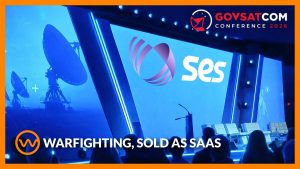

SES is making a public break with the polite fiction that space is “contested” and therefore mostly a planning problem. Adel Al-Saleh calls it warfighting, which is the verbal key that opens budgets and shuts down the usual timeline excuses. If you want a faster procurement cycle, you do not ask for it nicely. You describe the domain as a battlefield and let everyone else do the math.
Under the rhetoric sits a simpler commercial objective. SES wants to move from selling capacity to selling orchestration. The speech keeps praising interoperability, openness, and sovereign control, yet the real product is the digital layer that decides how traffic moves across orbits, across waveforms, and across partner networks. It is cloud control logic wrapped around satellites, with the charming promise that the customer gets “full control” inside slices. That last part is designed to soothe ministries that watched one LEO provider become a strategic dependency overnight.
The multi-orbit framing is also a confession delivered with confidence. SES is not going to chase LEO scale. It will partner for LEO and position MEO as the backbone, with GEO still doing what GEO does when physics is not negotiable. This is what you say when the market has a player with thousands of satellites and you would rather not donate your capex budget to a losing race. Starlink’s pace keeps reminding everyone that scale is no longer a theory project, it is already overhead and active.
The partner choices reveal what SES thinks its weakest link used to be. K2 Space shows up as the speed symbol, the manufacturing story that lets SES talk about bigger spacecraft without being laughed out of the room. SES has already said it will fly an on-orbit mission in Q1 2026 as a pathfinder step toward its next-gen MEO network, which is the industry’s polite way of saying “we are testing because we know what happens when we do not.” K2’s own fundraising and valuation messaging adds a layer of theater here too, because nothing says “credible supplier” like a $3B valuation before a first major flight, at least in the part of the economy that still believes valuation is a physical constant.
The NASA demo reference is not filler. NASA has been explicit about wanting commercial relay services and has SES Space and Defense involved under its Communications Services Project. This matters because it converts the “data relay” pitch into something that looks like a real procurement path rather than a concept diagram. It also lets SES talk about near-real-time sensor-to-ground workflows without having to claim it has solved the full in-space compute problem.
The life extension aside is the most grounded line in the whole talk. SES signed with Infinite Orbits for a GEO life extension mission using a docking vehicle called Endurance. That is not glamorous, which is why it is useful. It signals investor-friendly capex smoothing and a willingness to treat satellites as serviceable assets instead of disposable hardware. It also reveals a quiet acknowledgement that the cheapest satellite is the one you already paid for.
The most interesting contradiction is the one he never names. SES is pitching annual iteration and rapid prototyping while speaking to customers who are famous for slow requirements, slow certification, slow contracting. That tension does not go away because someone says “agile” in a keynote. SES is betting that warfighting urgency will bully bureaucracy into moving. It might, until the first oversight committee asks for a five-year plan in triplicate.
The deeper narrative is about who owns the choke point. If “independent isolated networks” cannot handle future missions, then the entity that offers integration becomes the unavoidable middle. SES is trying to make that middle look neutral, open, and sovereign. It is also trying to make it look European without being anti-American, which is a diplomatic dance that usually ends with everyone signing contracts and then arguing about them later.


SES: Sovereignty With Stock Tickers