
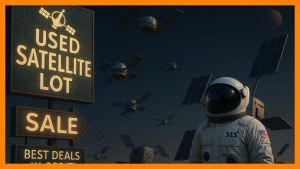

Or how to win the slow-race to space relevance by buying someone else’s crumbling satellite empire.
SES S.A., Luxembourg’s glittering contribution to the satellite sector, the company that asks, “Why move fast and break things when you can orbit slowly and buy them instead?”
In 2024, SES threw a $3.1 billion bouquet at Intelsat, a move best described as equal parts strategic synergy and low-orbit rescue mission. As the industry braces for low Earth orbit chaos courtesy of Elon Musk’s Starlink and Jeff Bezos’s Kuiper, SES figured the best way to face the future was to buy a company still emotionally tethered to the 1990s.
But let’s not jump ahead. SES had a solid-ish 2024, at least by legacy operator standards. Revenue dipped just 0.9%, which in satellite-speak is a win. Their government services division was the real MVP, growing 6.4%, presumably because someone in Brussels still remembers how to fax a purchase order. Their “Networks” segment also grew by 2.9%, largely driven by the kind of “trusted partner” contracts that only exist because European bureaucrats still distrust anything that sounds remotely like “Elon.”
Which brings us to the big cosmic elephant
Starlink. Musk’s internet-from-space machine is flooding the skies with satellites, offering faster speeds, lower latency, and the sort of disruptive pricing that makes SES’s traditional GEO/MEO offerings look like dial-up at a yoga retreat. In the face of this, SES’s plan is admirably bold: don’t compete with Starlink’s technology, just acquire someone else with even older technology and hope for the best.
Yes, the Intelsat acquisition. Originally priced at $3.1 billion, it was later discounted to $2.6 billion because Intelsat handed out half a billion dollars to shareholders like Oprah at a Favorite Things taping.
Why pay more when you can pay less and still inherit aging satellites, declining revenue streams, and a customer base already shopping for SpaceX routers?
But SES isn’t just banking on Intelsat’s sagging assets. They’re also betting big on Europe’s most ambitious group project yet: IRIS² a $10 billion moonshot (well, LEO-shot) to build the EU’s own sovereign constellation. SES is a key player in the SpaceRISE consortium, which sounds more like a startup that makes cold brew than a satellite operator, tasked with building the Continent’s firewall against Muskian dominance. It’s like Europe’s answer to Starlink, but with more bureaucracy and fewer memes.
So what’s the actual plan here?
SES is pushing its “multi-orbit” strategy, a fusion of geostationary satellites that are basically sky fossils and MEO satellites that orbit just a bit less sluggishly. The idea is that by offering “reliable coverage” and “global reach,” SES can still matter. Never mind that latency-sensitive applications like video gaming, remote surgery, and, you know, the modern internet, are increasingly leaning toward LEO. SES’s model is essentially the telecommunications equivalent of buying more landlines because smartphones are too mainstream.
And let’s not forget their subtle rebranding as a “high-value service provider.” Translation: if you can’t sell bandwidth cheaper or faster, just use fancier words. It’s the telecom version of “artisanal connectivity.”
To their credit, SES is trying. Their network isn’t small. Their government ties are deep. And their revenue hasn’t imploded, yet. But let’s be clear: this is a company betting that combining two slowly declining empires will somehow result in one that ascends.
It’s the Voltron strategy, except all the lion bots are missing parts and someone threw out the instructions in 2006.
So as SES prepares to finalize the Intelsat acquisition, they’re not just becoming the largest multi-orbit satellite operator outside the U.S., they’re becoming Europe’s most expensive response to a market they no longer control.
SES isn’t racing to the future. It’s jogging there, cautiously, in hiking boots, while Starlink builds highways overhead.
Will it work?
Maybe. But only if the future turns out to look suspiciously like the past. And even then, they’ll need a lot more acronyms, joint ventures, and EU funding to keep the orbit alive.

SES: Sovereignty With Stock Tickers