
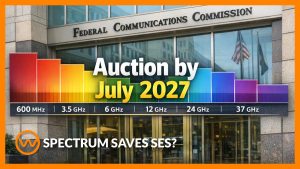

SES just got a tiny little reminder from Moody’s that debt has opinions. The downgrade itself is not apocalyptic. It is the sort of one-notch slap that says: we see your integration story, we see your synergy deck, and we also see your bills.
SES’s response was the usual calm confidence you get when someone insists they are totally fine. It kept repeating that investment grade is still the goal, deleveraging is still the plan, and the dividend will keep behaving like a well-trained pet. That last part is the tell. You do not reassure investors about a “stable-to-progressive” dividend unless you think they are about to get ideas.
BNP Paribas then arrives as the friendly adult in the room, offering an Outperform rating and a price target that makes the current share price look like a clerical error. The report wraps SES in the European sovereignty blanket, because nothing says “safe cash flows” like governments rediscovering that satellites exist. Defence spending rises, geopolitics stays unpleasant, and suddenly the same institutional buyers who used to negotiate like ruthless accountants are told to pay for resilience. Miracles happen.
Then we get to the part everyone actually cares about, because it is not a strategy slide. It is a potential check from the FCC. C-band is the closest thing this sector has to an ATM that occasionally prints nine-figure receipts if you survive the paperwork. The article treats this as a bonus, which is adorable. It is not a bonus. It is the industry quietly selling pieces of its future to cover the tab from its past.
The FCC wants upper C-band, because mid-band spectrum keeps being the centerpiece of every “5G and 6G” speech delivered by someone who has never configured a network. The plan is to auction at least 100 MHz and maybe more later, with a statutory deadline that sounds firm until you remember how Washington works. The docket is complicated enough that the FCC extended comment deadlines into late January and mid-February 2026, which is a polite way of saying: broadcasters, aviation stakeholders, and everyone else are warming up their lawyers.
SES can free up 180 MHz, it says, and the FCC will start with 100 MHz. That is where the banker math begins. BNP throws out a value north of €1 billion for that first chunk and calls it “material optionality,” because bankers do not say “lottery ticket” in print. Their valuation range is wide enough to fit most emotional needs. The low end gives you a big number to post in a slide deck. The high end gives you the kind of figure that makes people forget taxes exist.
The 2020 C-band auction is used as a comforting reference point, because it produced huge proceeds and even bigger self-congratulation. The satellite operators were paid to clear, and the wireless industry got its prized mid-band. The article leans on those prior incentive payments as a benchmark, because it makes the next payout feel familiar. Familiar is good when you are trying to persuade investors that a downgrade is temporary.
There is just one detail. SES bought Intelsat, and with it, a very specific agreement that sends 42.5% of net proceeds from up to 100 MHz of any future monetization to Intelsat’s former shareholders. That means the first tranche of upside has a toll booth. After that, SES keeps the rest. The structure makes sense if you needed to bridge a valuation gap to close a deal. It is less exciting if you are pitching “we own Intelsat so we get more,” because “more” has an asterisk attached.
The competitive argument against rich valuations is also not imaginary. Starlink keeps expanding, regulators keep approving more satellites, and Amazon keeps launching batches for its own network. This is the part the GEO incumbents hate. It is harder to sell “scarce capacity” when the sky is filling with it. It does not mean SES becomes irrelevant. It does mean that the market will ask why it should pay 2020-style prices for 2027-era spectrum capacity economics.
SES still has a coherent endgame if the auction proceeds land in the expected range. A big cash receipt reduces leverage, credit metrics improve, and the investment grade story gets a second life. It also funds the kind of European secure connectivity projects politicians like to talk about, especially when they want to avoid saying “we are dependent on an American company run by a man who tweets through diplomatic incidents.”
The risk is not that SES cannot clear spectrum. The risk is the calendar, the politics, and the temptation to promise everyone everything. Deleveraging wants the cash. IRIS2 wants the cash. Shareholders want the cash. The market will eventually ask which one is real, because money is annoyingly finite.
If you want the cynical version, SES is trying to refinance trust. Moody’s asked for proof. SES offered a future event. BNP offered a valuation narrative. The FCC offered a rulemaking docket. The only truly reliable part is that the debate will be loud, expensive, and dressed up as national interest.


SES: Sovereignty With Stock Tickers