
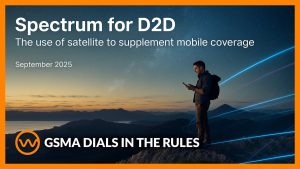

We read the Spectrum for D2D paper from the GSMA and they have finally written down what many in the mobile world were saying quietly: if satellites want to talk directly to phones, they need to ask permission from the mobile operators who already hold the keys to the spectrum. The new policy paper dresses this up as a rational framework for coexistence, but the underlying message is obvious. D2D is welcome, but only as a polite guest in the house that IMT built.
The paper insists on describing D2D as a supplement, not a substitute. That neat phrase means satellites should handle the gaps, disasters and far-off corners, but never aspire to stand next to terrestrial 5G in cities or suburbs. If you had grand ideas of broadband satellites eating into operator turf, the GSMA would like you to sit down again. Their technical justification is footprint size and limited area throughput. The real reason is turf protection.
Licensing is the crux. In IMT bands, satellites must operate under the umbrella of existing MNO licences. No parallel authorisations, no separate market entry, no spectrum independence. The satellite can only show up as a wholesale partner. In other words, carriers get the veto power, the billing control and the regulatory shield. For anyone hoping to sell a direct retail satellite service into phones, this is a door slamming shut.
On interference, the GSMA is generous in theory and brutal in practice. IMT always comes first. Satellites in IMT bands can only be secondary, non-protected and disposable if they clash with terrestrial services. The polite phrase is “no interference, no protection.” Which in plain terms means: if there is a problem, the satellite always loses.
The paper does recognise the 3GPP MSS bands, those shiny n254 to n256 allocations where the satellite industry actually has rights. But it quickly points out that handsets do not support them widely, and that only high-end devices carry the extra hardware. Translation: the IMT bands are the only way to reach real scale today, and those bands are controlled by MNOs.
The looming fight is WRC-27, with three agenda items colliding. Direct-to-device in 694 MHz to 2.7 GHz, more MSS allocations for sat-IoT, and extra MSS inside bands already buzzing with IMT. The GSMA waves a warning flag about fragmentation and then offers the neat solution: protect IMT above all else, assign satellites a safe secondary status, and keep the operator in charge.
The unsaid is more interesting. If satellites must operate through carriers, then the MNO becomes both gatekeeper and rent collector. Consumers will still hear the marketing line about “standard phones working everywhere,” but every commercial deal will flow through the mobile operator. Technical challenges like Doppler compensation, timing advance, uplink limits and lawful intercept obligations are brushed aside with a vague promise of “technical limits.” The heavy lifting is someone else’s problem.
For satellites, this is not the path to retail glory. It is the path to wholesale contracts, negotiated under carrier terms. For MNOs, it is leverage and protection. For regulators, it is a pre-cooked solution they can adopt without inventing new categories. For handset makers, it is a fork in the road: keep software-only tweaks for IMT D2D, or invest in hardware for MSS bands that may take years to scale.
The GSMA is playing a long game. Keep the spectrum landscape tidy, stop fragmentation before it begins, and lock satellites into the operator value chain. The language is polished, the framing careful, but the strategy is blunt. D2D will not bypass the operator. It will be absorbed by it.


SES: Sovereignty With Stock Tickers