
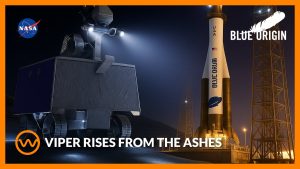

Dragged to the Moon by Bezos’ Backhoe
Apparently, the Moon is back on the menu (again) with NASA reviving the previously-canceled VIPER rover mission like a zombie on government life support. And who better to drag it to the lunar surface than Blue Origin, the company still trying to finish what it started before Elon got bored of Mars and pivoted to chip implants and cage fights.
For the low, low price of $190 million, Blue Origin gets a second shot at pretending it’s a lunar logistics company. NASA handed out a CLPS (Commercial Lunar Payload Services) task order that technically isn’t a delivery contract, yet. It’s just a “maybe we’ll let you do this if you don’t blow up your lander first” kind of deal. The actual delivery is an option. Which, in federal speak, means, “We’re hedging.”
The lander in question is Blue Moon MK1. Sounds impressive until you remember it hasn’t flown. Its first flight is supposed to happen later this year, carrying what amounts to glorified camera tripods and reflectors. Only if that goes well does Blue Origin get to earn its Moon Uber badge and take VIPER for a ride. Until then, it’s all P-Points and “demo caps.”
VIPER, the rover that was so vital NASA previously canceled it for being too expensive and too late, is now critical again. Not because something changed scientifically, but because the optics of letting a $400M robot rot in a cleanroom during Artemis hype season were probably too much for Congress. You can almost hear the pitch: “It’s already built, kinda. Let’s slap it on Bezos’ sled and hope for the best.”
NASA, for its part, is spinning this as an elegant pivot toward commercial partnership. That’s code for “please let someone else take the PR hit if this goes sideways.” Blue Origin now owns not just the landing system, but also the integration, deployment, testing, and other stuff that used to be called, unironically, “the hard part.”
But it’s all fine. VIPER’s only going to one of the most technically punishing places on the Moon: the permanently shadowed, icy craters of the south pole. No sunlight, sub-zero temperatures, terrain that makes Mars look like a parking lot. What could go wrong?
The real genius is in the contract’s structure. Blue Origin has to prove it can even build the rover deployment system before NASA commits to letting it fly. That’s like hiring a moving company, but first making them build their own truck, pass a driver’s test, and survive a demo job before you let them near your grandmother’s piano.
And yet, this is being hailed as another example of American space leadership. Which is technically true, if you measure leadership in “most press releases per dollar burned.” The Artemis program is apparently so robust it can cancel missions, then uncancel them, then call that innovation.
If Blue Origin pulls this off, it could become a legit lunar player. If not, VIPER gets shelved again, the rover team updates their résumés, and we all pretend this version of the mission never existed.
Either way, a few things are certain.
Lunar ice will remain unfound for a while longer.
NASA will hold more press conferences.
And the private space sector will continue charging taxpayers to test their prototypes.